
Cooperation with African countries in chemical industry
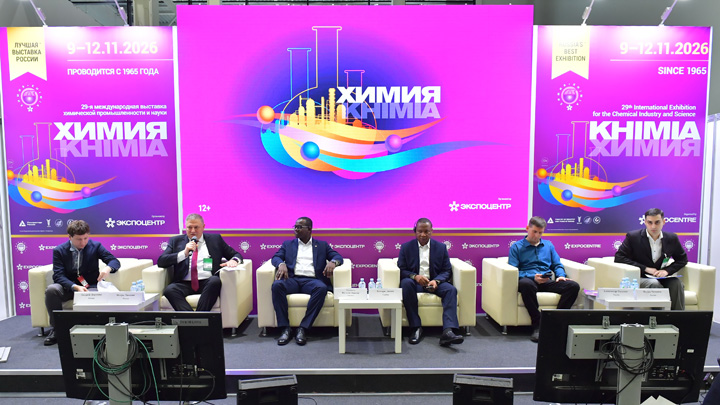
A Panel on Relevant Issues of Chemical Supplies to African Countries took place within the Khimia 2026 conference programme. Its participants discussed export opportunities of Russian enterprises, needs of African businesses, and prospects for setting up joint ventures.
The event was attended by representatives of Russian and African businesses, the scientific community, as well as the diplomatic missions of Sierra Leone, Nigeria and the Republic of the Gambia in the Russian Federation.
Igor Lyashkov, Head of the Center for Production System Development of the Chemical Complex, moderated the panel. He suggested focusing on practical cooperation opportunities that would allow Russian and African companies to reduce production costs, increase efficiency, and find new sources of income.
Andrey Dorokhin, Head of the Department of Foreign Trade Analytics at the Moscow Department of Foreign Economic and International Relations, spoke about the export potential of Moscow’s enterprises. According to him, Moscow brings together companies in the chemical and pharmaceutical industries and helps them enter foreign markets. Among the promising areas of supply to African countries, he singled out ready-made medicines, perfumery and cosmetics, household chemicals, detergents, as well as paints and coatings.
The speaker highlighted the importance of the price-quality ratio of Russian products and stressed that the development of cooperation should open up opportunities, including for small and medium-sized businesses. To enter new markets, companies need support in finding partners, arranging payments, and distributing. Andrey Dorokhin named natural components that can be used by Russian manufacturers among the supplies from African countries to Russia.
Islam Chechenov, General Director at OPTIMA, a junior researcher at the Institute of Petrochemical Synthesis of the Russian Academy of Sciences, spoke about the experience of developing chemical industries based on local raw materials. According to him, Zimbabwe has launched the first stage of a project for processing sugar-containing raw materials and by-products of sugar cane processing. Another direction is the production of activated carbon. The Institute of Petrochemical Synthesis and Mendeleev University of Chemical Technology were involved in research for the project.
Islam Chechenov also spoke about working with existing enterprises in Africa: developing formulations, selecting raw materials and equipment, and improving technologies. Such solutions help to optimize costs and replace individual components, taking into account environmental requirements, while maintaining the necessary material properties.
Alexander Tolstov, OPTIMA's Technical Director, elaborated on the engineering support of projects, from the development of materials and obtaining laboratory samples to testing, selection of technological modes, and pre-production. The speaker noted that his company is also ready to help existing enterprises identify the causes of defects, adjust formulations and processing modes, prepare technical documentation, and train staff.
Mussenge Philippe Marques, a business representative from Angola, spoke about the prospects for cooperation between Russian lubricants manufacturers and logistics companies on the African continent. He suggested taking into account the prominence of Russian automotive technology in Angola when promoting oils and related products, as well as developing partnerships from distribution and service to localization of production.
The speaker paid special attention to the logistics infrastructure of Angola, including the ports of Luanda and Lobito. According to him, the development of the Lobitu transport corridor opens up additional opportunities for supplies to neighboring countries–the Democratic Republic of the Congo and Zambia. Among the promising formats of cooperation, he named the creation of production facilities in economic zones and the gradual expansion of cooperation as practical results are achieved.
The event was also attended by Rosetta Mayealie Conteh, First Secretary of the Embassy of the Republic of Sierra Leone in the Russian Federation, Charles Tefla Arzo and Olajide Babatola Owoka, Special Advisers to the Head of the Diplomatic Mission of the Federal Republic of Nigeria in the Russian Federation, Bakary Jawo, First Secretary of the Embassy of the Republic of the Gambia in the Russian Federation, Bakary S. Sonko, Special Adviser of the Embassy of the Republic of the Gambia in the Russian Federation, and Brian Mugabi, Head of the Diplomatic Mission of the Republic of Uganda in the Russian Federation.
The discussion showed that cooperation in the chemical industry can include not only the supply of finished products, but also the processing of local raw materials, technology transfer, and training of specialists.
Khimia 2026 provided the participants with an opportunity to get acquainted with the solutions of Russian enterprises and discuss specific areas of partnership.
Press Service, EXPOCENTRE AO